


67% of current online daters around the world would consider dating an AI chatbot.

Start typing to see suggestions.
-
Start typing to see suggestions.

Creating your recommendation

Did you know?
Around 30% of phishing emails are opened.
81 Phishing Attack Statistics 2023: The Ultimate Insight published by Astra, April 2023.
More than 130 million Americans have been affected by cybercrime.
Based on an online survey of 1,001 adults in the U.S. conducted by The Harris Poll on behalf of Gen™ (formerly NortonLifeLock), November–December 2022.
Your personalized matches

60-day money-back guarantee
*Important subscription, pricing, and offer details:
- By subscribing, you are purchasing a recurring subscription which will automatically renew.
- The price quoted today is valid for the offered introductory term. After that, your subscription will be billed at the applicable monthly or annual renewal price here. The price is subject to change, but we will always send you a notification email in advance.
2 Requires an automatically renewing subscription for a product containing antivirus features. For further terms and conditions, please see norton.com/virus-protection-promise.
4 Only available on Windows systems (but not in S mode or on ARM processors).
21 Utilities Ultimate, Driver Updater, Software Updater, and Cloud Backup features are only available on Windows (excluding Windows in S mode and Windows running on ARM processor).
‡ Monitoring available on Windows™ PC, iOS, and Android™ devices. Not all features available on all platforms.
§ Monitoring not available in all countries and varies based on region.


Norton Insights Report: Artificial Intimacy
Daters turn to algorithms for love amid a loneliness epidemic
Global results
Survey methodology
The study was conducted online within 14 countries (US, UK, AUS, BR, MX, CZ, FR, DE, JP, NZ, IT, HK, CL, CO) by Dynata on behalf of Gen from July 24th to 16th August, 2025 among 14,003 adults ages 18 and older. Data are weighted where necessary by age, gender, and region, to be nationally representative.
Executive summary
Loneliness is reshaping how online daters seek connection online, with artificial intelligence increasingly filling emotional roles once reserved for human relationships. As AI-powered tools become more present in dating, therapy, and relationship advice, many individuals are forming deeper bonds with technology, often faster than they realize. While these tools can feel supportive and accessible, they are also creating new opportunities for emotional manipulation and fraud.
This report dives into the results of a global survey that asks people how they feel about online dating and loneliness in the age of AI.
“AI itself isn’t a scam, and our research shows that for many people it genuinely feels supportive or comforting. But when loneliness is high, trust can form very quickly online, and that’s exactly when scammers tend to step in. As more people look for connection through apps, chatbots, and digital tools, it becomes even more important to pause, protect personal information, and remember that real trust should never come with pressure or secrecy.”

Leyla Bilge
Global Head of Scam Research for Norton
Key insights
Crushing on code with LLMs


37% of current online dating app users believe you can develop romantic feelings for an AI chatbot.

A global look at who’s open to dating AI
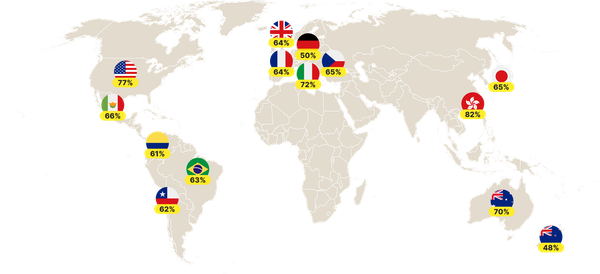
A world map showing what percent of people are open to dating AI in certain countries.
We asked respondents whether they would be open to dating AI. Openness was highest in Hong Kong (82%) and the U.S. (77%). In Europe, 72% of respondents in Italy said they’d consider it, along with 65% in Czechia, 64% in the UK and France, and 50% in Germany. In Latin America, 66% of respondents in Mexico, 63% in Brazil, 62% in Chile, and 61% in Colombia said they’d be open to dating AI. In the Asia-Pacific region, 65% of respondents in Japan and 70% in Australia expressed openness, compared to just 48% in New Zealand.
AI is boosting dating lives


Online daters are generally accepting of using AI to support their dating life. The most popular ways they would use AI are for writing pick up lines (57%), enhancing their photos (56%), and developing their dating app profile (54%).

However, there is some hypocrisy: 64% of online daters said it would bother them if they found out their match used AI to modify their pictures or draft their prompts.
Trusting machines more than humans

61% say they would trust an AI coach more than a human friend or family member for relationship advice.

42% believe that an AI partner would be more emotionally supportive than a human partner.

52% have sought out advice from an AI chatbot or assistant.
Key takeaway: AI is changing how online daters experience connection, especially at a time when many feel isolated or unsupported.
Lots of loneliness

81% of respondents say they experience loneliness, with the highest percentages among the youngest generations.
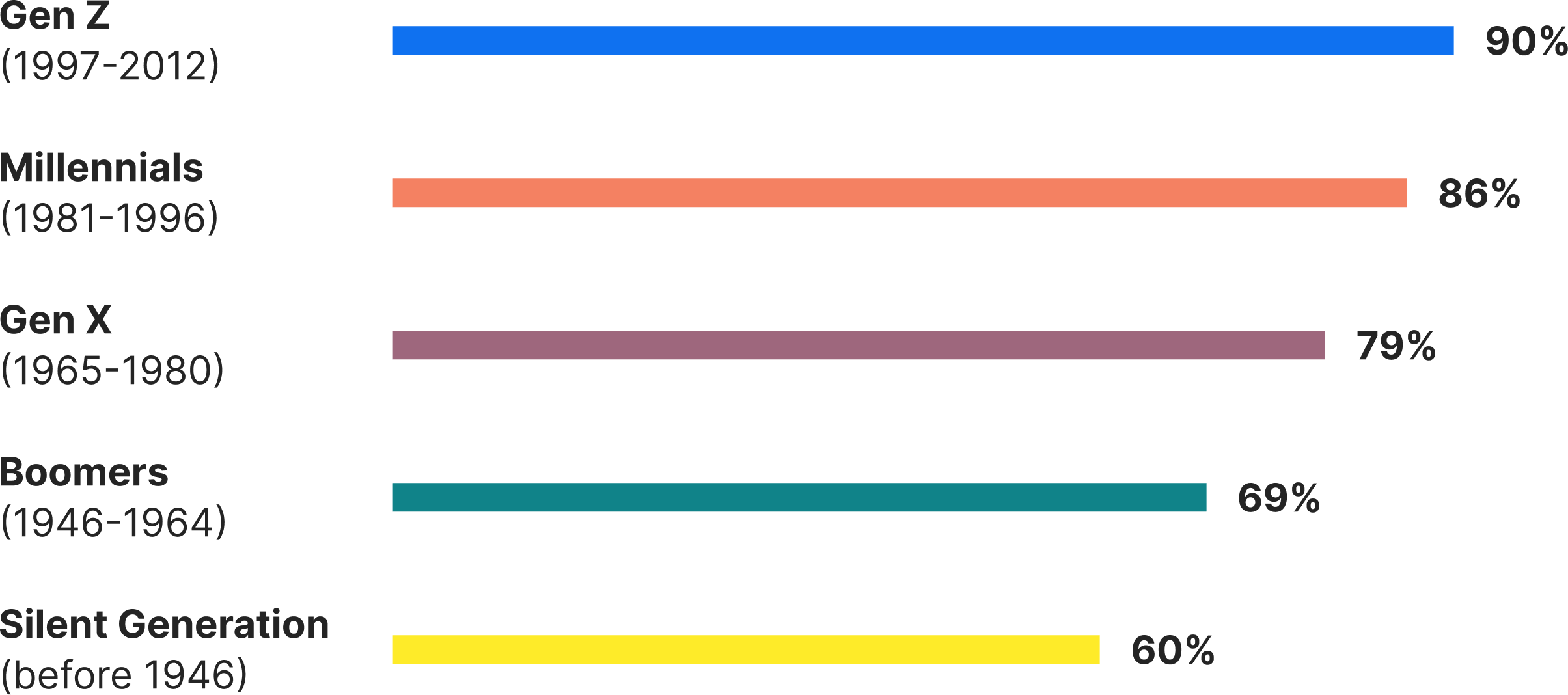
Survey findings indicate that 90% of Gen Z respondents (born between 1997 and 2012) report experiencing loneliness, compared to 86% of Millennials (born 1981-1996), 79% of Gen X (born 1965-1980), 69% of Baby Boomers (born 1946-1964), and 60% of the Silent Generation (born before 1946).

31% say that their feelings of loneliness have increased since Covid.

24% admit that loneliness leads them to make more risky decisions when it comes to online dating.

Feeling alone: A shared global experience
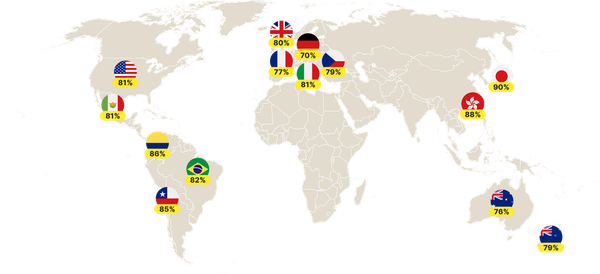
A world map showing what percent of respondents in different countries experienced loneliness.
We commissioned a survey to determine how widespread feelings of loneliness are in different countries. 90% of respondents in Japan reported feeling alone, compared to 88% of respondents in Hong Kong, 86% in Colombia, 85% in Chile, 82% in Brazil, 81% in Italy, 81% in Mexico, 81% in the U.S., 80% in the UK, 79% in New Zealand, 79% in Czechia, 77% in France, 76% in Australia, and 70% in Germany.
Dangers of dating scams
Romance Scams: When someone is tricked into believing they are in a relationship with someone they met online, but that person is a scammer with the intention of building trust with the victim to gain access to money.

34% of current online daters have been targeted by a scam; of this group, 64% have fallen victim to one.

36% of current online daters have been pressured to send money to someone they met online.
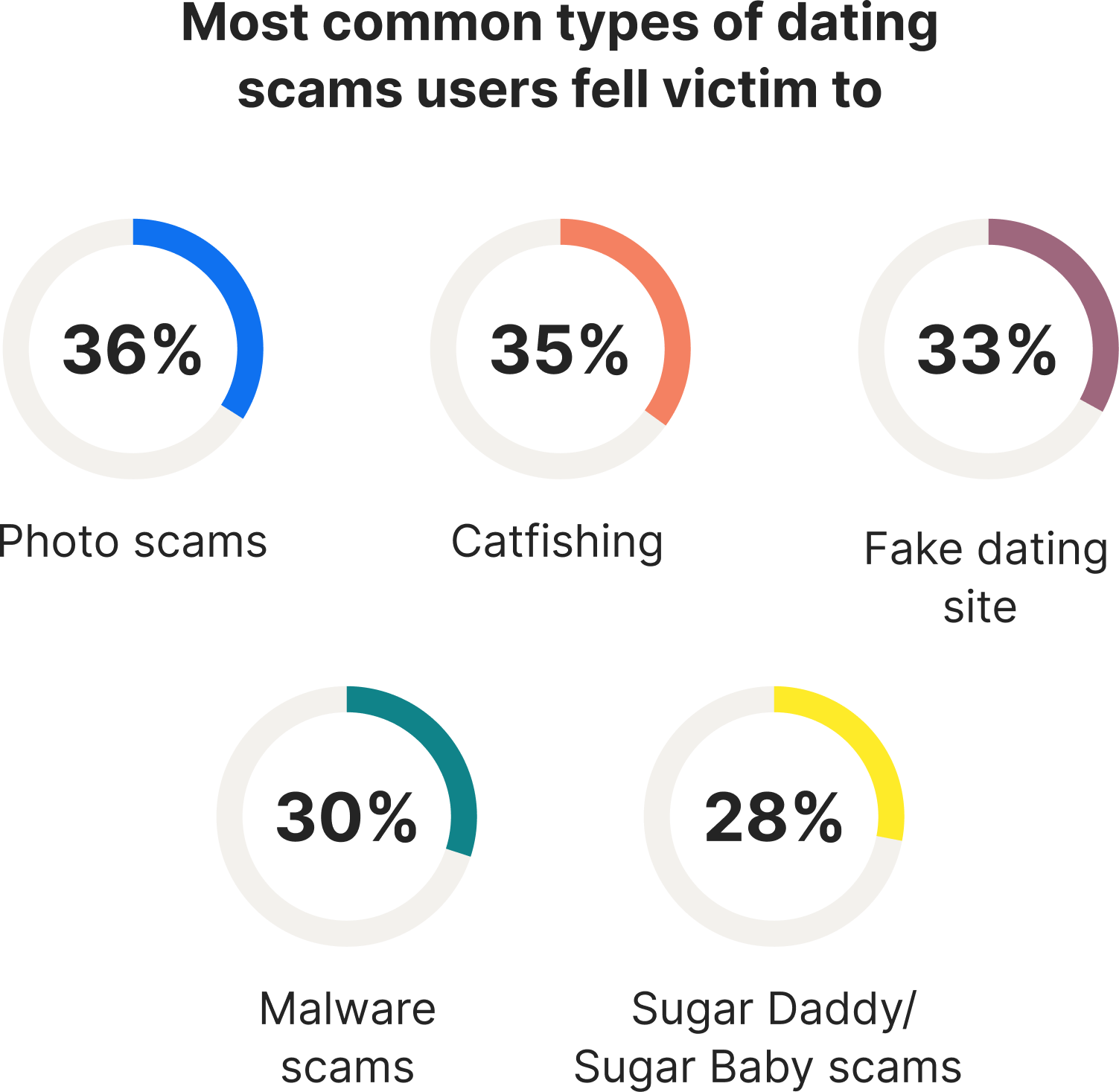
According to our survey findings, 36% of respondents said they had fallen victim to a photo scam, 35% to catfishing, 33% to a fake dating site, 30% to a malware scam, and 28% to a sugar daddy or sugar baby scam.
Warnings signs of romance scams

|
They avoid video calls: Historically, scammers have tried to avoid live communication because they can’t hide their true identity. Now, AI tools make it surprisingly easy to create convincing deepfake videos without advanced technical skills. |
|
|
They don’t have many followers or friends: Scammers tend to keep their social circle small to fly under the radar. Look at the profiles of people who interact with them, including their photos, comments, and activity. |
|
|
They avoid meeting in person: Because of this, cybercriminals will target people outside their geographic region. |
|
|
They use stolen pictures: These may be stock images, pictures of models, or photos from real accounts. Use a reverse image search tool to see if the photos appear elsewhere online. |
|
|
They act over the top: Scammers may try to “love-bomb” victims to build trust. If you notice a person trying to rapidly escalate a relationship, take a step back and assess before you continue engaging with them. |
|
|
They ask you for money: Never send money to anyone you’re unable to confirm the identity of, no matter what story they tell you. |
How to make your dating profile safer

|
Use two-factor authentication when using a dating app or website. |
|
|
Make your profiles private and vet follower requests. |
|
|
Don't include your full name in your profile. |
|
|
Avoid giving away personal information in your profile, biography, or photos. |
Learn more, stay safer
Expand your online safety know-how.


Want more?
Follow us for all the latest news, tips, and updates.