
Start typing to see suggestions.
-
Start typing to see suggestions.


Protection you don’t have to think about
Choose a plan that keeps you protected from scams and other threats, we’ll look after the rest.

This month, get ahead of smarter scams.
This Cybersecurity Awareness Month, protect yourself against scams you can't always see coming with Norton 360.



Creating your recommendation

Did you know?
Around 30% of phishing emails are opened.
81 Phishing Attack Statistics 2023: The Ultimate Insight published by Astra, April 2023.
More than 130 million Americans have been affected by cybercrime.
Based on an online survey of 1,001 adults in the U.S. conducted by The Harris Poll on behalf of Gen™ (formerly NortonLifeLock), November–December 2022.
Your personalized matches

60-day money-back guarantee
*Important subscription, pricing, and offer details:
- By subscribing, you are purchasing a recurring subscription which will automatically renew.
- The price quoted today is valid for the offered introductory term. After that, your subscription will be billed at the applicable monthly or annual renewal price here. The price is subject to change, but we will always send you a notification email in advance.
2 Requires an automatically renewing subscription for a product containing antivirus features. For further terms and conditions, please see norton.com/virus-protection-promise.
4 Only available on Windows systems (but not in S mode or on ARM processors).
21 Utilities Ultimate, Driver Updater, Software Updater, and Cloud Backup features are only available on Windows (excluding Windows in S mode and Windows running on ARM processor).
‡ Monitoring available on Windows™ PC, iOS, and Android™ devices. Not all features available on all platforms.
§ Monitoring not available in all countries and varies based on region.

- Protection for 1 Android™ smartphone or tablet
- Scam Protection
- WiFi Security
- Internet Security
- Device Security
1 year of protection for 1 mobile device.
Savings compared to the renewal price of $29.99/year.
See subscription details below.*
Your purchase of Norton 360 Deluxe and Norton 360 with LifeLock plans also includes Norton Mobile Security. Get its features and additional protection for your devices, online privacy, and personal information, all in a single solution.
 60-day money back guarantee
Looking for iPhone® or iPad® protection?
- Protection for 1 iPhone® or iPad®
- Scam Protection
- Wi-Fi Security
- Internet Security
- Device Security
1 year of protection for 1 mobile device.
Savings compared to the renewal price of $29.99/year.
See subscription details below.*
Your purchase of Norton 360 Deluxe and Norton 360 with LifeLock plans also includes Norton Mobile Security. Get its features and additional protection for your devices, online privacy, and personal information, all in a single solution.
60-day money back guarantee
Buy the protection that’s right for you.
All plans below include antivirus, Scam Protection, VPN, Dark Web Monitoring§, Password Manager and Deepfake Protection23,33.
Norton 360
Standard
Best for those who want essential device protection for their devices.
57% OFF*
$94.99
$39.99
first yr.
It works out as
$3.33
/month
- 3 PCs, Mac, tablets, or phones
- Antivirus, malware, ransomware, and hacking protection
- Scam Protection
- 100% Virus Protection Promise2
- 2 GB Cloud Backup4
- Password Manager
- Deepfake Protection23,33
- VPN
- Dark Web Monitoring§
Savings compared to the renewal price of $94.99/year.
See subscription details below.*
60-day money back guarantee
Norton 360
Deluxe
Best for families managing multiple devices and kids online.
60% OFF*
$124.99
$49.99
first yr.
It works out as
$4.17
/month
- 5 PCs, Mac, tablets, or phones
- Antivirus, malware, ransomware, and hacking protection
- Scam Protection
- 100% Virus Protection Promise2
- 50 GB Cloud Backup4
- Password Manager
- Deepfake Protection23,33
- VPN
- Dark Web Monitoring§
- Privacy Monitor
- Parental Control‡
Savings compared to the renewal price of $124.99/year.
See subscription details below.*
60-day money back guarantee
Norton 360 with LifeLock
Select Plus
Best for maximum protection, including your finances and identity.
47% OFF*
$189.99
$99.99
first yr.
It works out as
$8.33
/month
- 10 PCs, Mac, tablets, or phones
- Antivirus, malware, ransomware, and hacking protection
- Scam Protection Pro
- 100% Virus Protection Promise2
- 250 GB Cloud Backup4
- Password Manager
- Deepfake Protection23,33
- VPN
- Dark Web Monitoring§
- Privacy Monitor
- Parental Control‡
- LifeLock identity theft protection
- Stolen Wallet Protection
- Social Security & Credit Alerts‡
- Credit Monitoring Coverage: One bureau3
- Up to $25,000 in Stolen Funds Reimbursement†††
Savings compared to the renewal price of $189.99/year.
See subscription details below.*
60-day money back guarantee
Find what fits your digital life.
Norton™ 360 with LifeLock™ plans
Devices + online privacy + identity protection
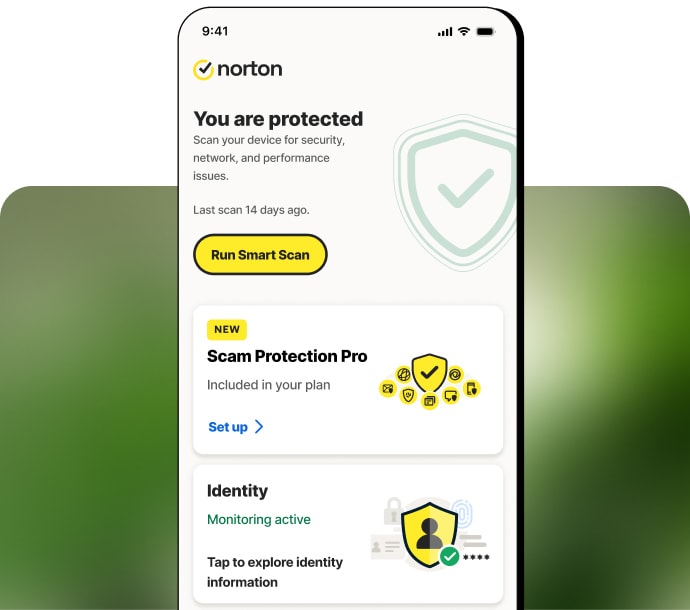
Protect your devices, privacy, and identity in one plan. Scam Protection Pro blocks scam calls, detects scams online and in emails, and identity theft support helps restore your identity and reimburse stolen funds.⁵,†††

Norton™ 360 plans
Devices + online privacy protection
Genie’s AI engine scans SMS messages for sophisticated scams so you can check your texts with peace of mind, device security blocks hackers, and Norton VPN helps keep your online activity private.
Norton™ VPN plans
Advanced online privacy protection
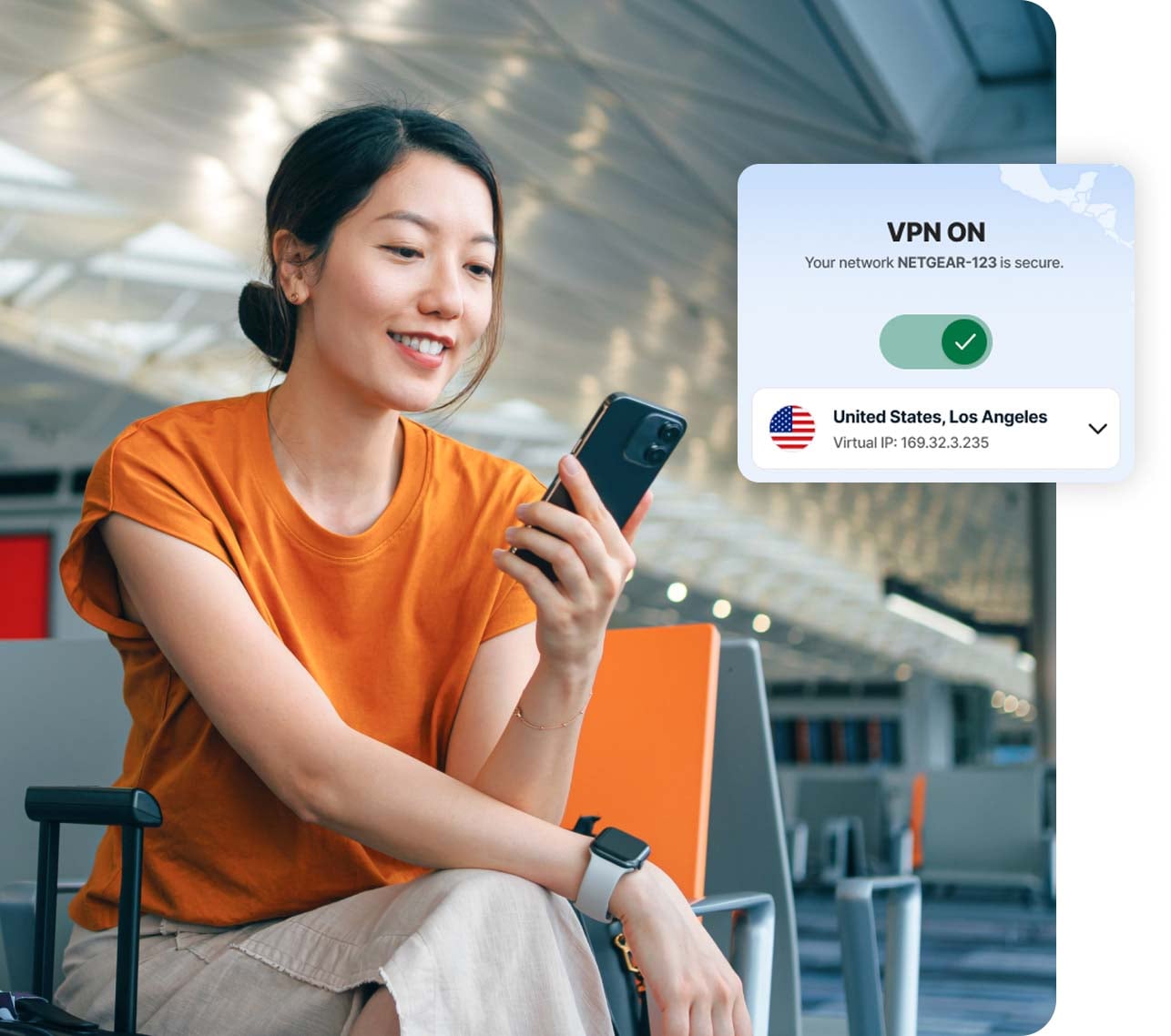
Stay safer online with a top-performing VPN, access your favorite content around the world, and safeguard your personal information with Password Manager and Dark Web Monitoring.

Norton Small Business
Protect your small business, no matter where you are.
Enjoy peace of mind knowing your business’s devices and customer data are more secure.
Trusted by millions of customers.

Norton technology blocks thousands of threats every minute.

Count on decades of experience and a proven track record of keeping people safer every day.

Get the protection you and your family need in one place.



Expert advice to stay protected.
Related articles

9 online safety tips for kids, teens, and parents
Help your children navigate the internet safely with these online safety tips for kids and teens.

Why you need a VPN for streaming
Learn how a VPN lets you access content on the go and why Norton VPN is the best VPN for streaming.

What is an AI agent? How it works and ways to use it
What is an AI agent? Learn how agentic AI works, see real-world examples, and discover how you can use AI agents safely.
No one can prevent all cybercrime or identity theft.
- Details: Subscription contracts begin when the transaction is complete and are subject to our Terms of Sale and License & Services Agreement. For trials, a payment method is required at sign-up and will be charged at the end of the trial period, unless canceled first.
- Renewal: Subscriptions automatically renew unless the renewal is canceled before billing. Renewal payments are billed annually (up to 35 days before renewal) or monthly depending on your billing cycle. Annual subscribers will receive an email with the renewal price beforehand. Renewal prices may be higher than the initial price and are subject to change. You can cancel the renewal as described here in your account or by contacting us here or at 844-488-4540.
- Cancellation and refund: You can cancel your contracts and get a full refund within 14 days of initial purchase for monthly subscriptions, and within 60 days of payments for annual subscriptions. For details, visit our Cancellation and Refund Policy. To cancel your contract or request a refund, click here.
2 Requires an automatically renewing subscription for a product containing antivirus features. For further terms and conditions, please see norton.com/virus-protection-promise.
3 If your plan includes credit reports, scores, and/or credit monitoring features ("Credit Features"), two requirements must be met to receive said features: (i) your identity must be successfully verified with Equifax; and (ii) Equifax must be able to locate your credit file and it must contain sufficient credit history information. IF EITHER OF THE FOREGOING REQUIREMENTS ARE NOT MET YOU WILL NOT RECEIVE CREDIT FEATURES FROM ANY BUREAU. If your plan also includes Credit Features from Experian and/or TransUnion, the above verification process must also be successfully completed with Experian and/or TransUnion, as applicable. If verification is successfully completed with Equifax, but not with Experian and/or TransUnion, as applicable, you will not receive Credit Features from such bureau(s) until the verification process is successfully completed and until then you will only receive Credit Features from Equifax. Any credit monitoring from Experian and TransUnion will take several days to begin after your successful plan enrollment.
4 Cloud Backup features are only available on Windows (excluding Windows in S mode, Windows running on ARM processor).
5 Restrictions apply. Automatically renewing subscription required. If you're a victim of identity theft and not satisfied with our resolution, you may receive a refund for the current term of your subscription. See LifeLock.com/Guarantee for complete details.
23 Automatic Deepfake Protection works only for videos in English on supported social media/video platforms; use manual scan on other platforms. Requires Windows 11 or later and a supported browser. Automatic detection additionally requires either an AI PC (minimum 8‑core Qualcomm or Intel CPU, 16 GB RAM) or a non‑AI PC (minimum 6‑core CPU from any brand, 16 GB RAM). On non‑AI PCs with a minimum 4‑core CPU, 8 GB RAM, only manual scan is available. For full details, see Norton.com/deepfakesupport.
33 Deepfake Protection in Norton Genie AI Assistant is currently available in early access and only YouTube videos in English are supported.
††† Up to $1 million for coverage for Lawyers and Experts, collectively, if needed, for all plans. Reimbursement and expense compensation varies according to plan—up to $1 million for Ultimate Plus, up to $100,000 for Advantage, and up to $25,000 for Standard. Benefits under the Master Policy are issued and covered by third-party insurance companies.
‡ Norton Family/Parental Control can only be installed and used on a child’s Windows™ PC, iOS, and Android™ device, but not all features are available on all platforms. Parents can monitor and manage their child’s activities from any device—Windows PC (excluding Windows in S mode), Mac, iOS, and Android—via our mobile apps, or by signing in to their account at my.Norton.com and selecting Parental Control via any browser. Mobile app must be downloaded separately. The iOS app is available in all except these countries.
§ Dark Web Monitoring is not available in all countries. Monitored information varies based on country of residence or choice of plan. It defaults to monitor your email address and begins immediately. Sign in to your account to enter more information for monitoring.
Enter a promocode and click "Apply"


